Skip to content
Neural Network World

Neural Network World

Independent AI News & Analysis

Primary Menu
  • AI News
  • AI Business
  • AI Research
  • AI Ethics
  • Machine Learning
  • Robotics
Light/Dark Button
Subscribe
  • Home
  • Robotics
  • Physical AI in 2026: Robots Are Leaving the Lab and Entering the Factory Floor
  • Robotics

Physical AI in 2026: Robots Are Leaving the Lab and Entering the Factory Floor

Neural Network World Editorial Team March 28, 2026 (Last updated: April 1, 2026) 4 minutes read
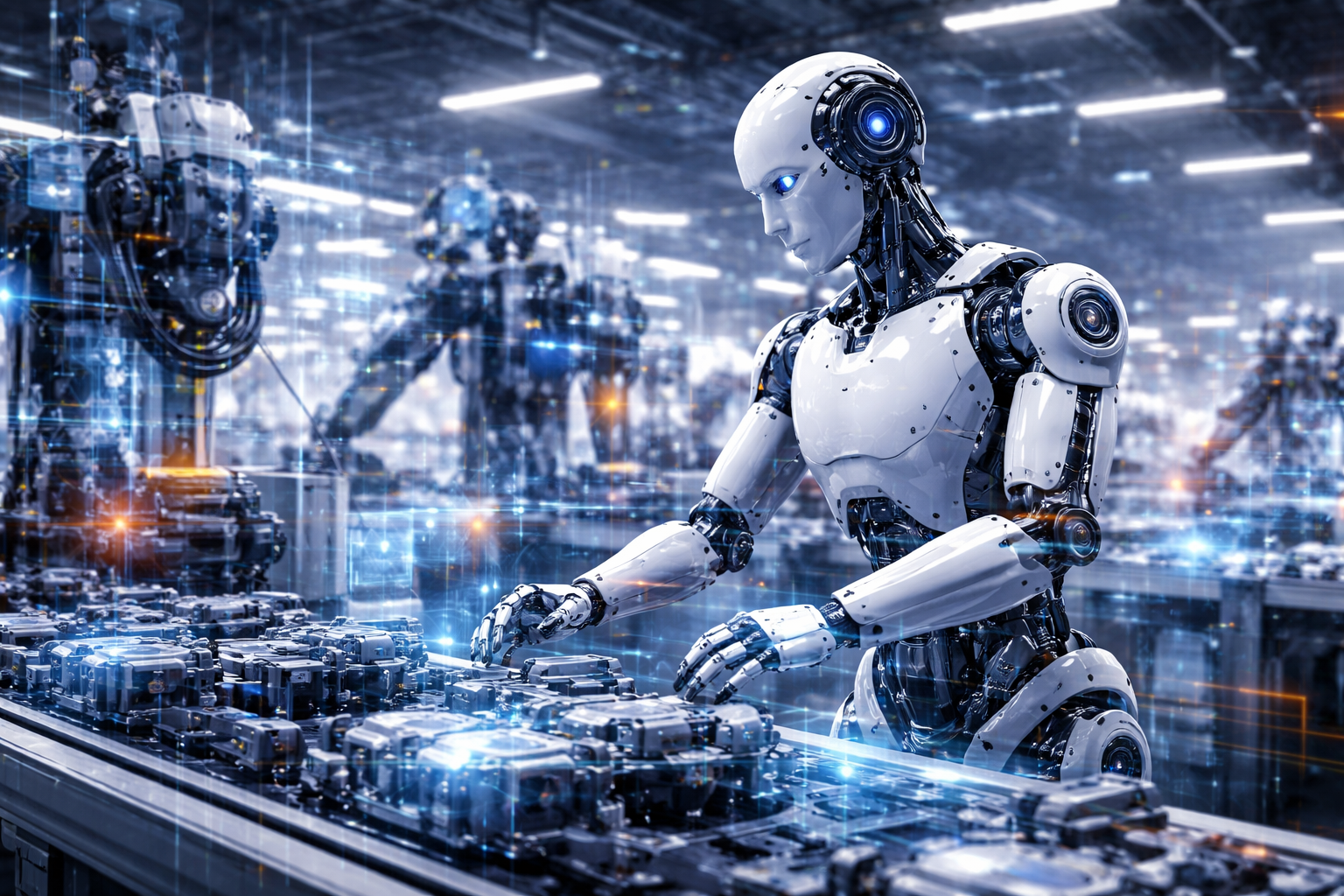
Humanoid robot working on an industrial assembly line

Concept illustration of physical AI deployment in manufacturing with a humanoid robot on a factory floor.

For years, the most impressive robot demonstrations lived on conference stages and YouTube videos. In 2026, that is changing. Physical AI – the integration of artificial intelligence with robotic hardware that operates in the real world – is making the leap from controlled lab environments to production floors, warehouses, and logistics centers.

NVIDIA CEO Jensen Huang captured the moment at the company’s GTC 2026 conference in March, declaring that the “ChatGPT moment for robotics is here.” Behind the headline, a convergence of breakthroughs in simulation, sensor technology, and AI models is making this transition possible.

The Simulation-to-Reality Breakthrough

One of the most persistent challenges in robotics has been the “sim-to-real” gap – the difference between how a robot performs in a simulated environment and how it handles the messy unpredictability of the real world. In March 2026, ABB and NVIDIA announced they had effectively closed this gap for industrial robotics applications.

Using NVIDIA’s Omniverse platform, manufacturers can now create high-fidelity digital twins of entire factory environments, train robots in simulation, and deploy them in physical settings with minimal additional tuning. This dramatically reduces the time and cost of robot deployment, which has historically been one of the biggest barriers to adoption.

New Open Models for Robot Learning

NVIDIA released several open physical AI models in March 2026, including updates to its Cosmos and GR00T frameworks. These models allow robots to understand their physical environment, reason about objects and obstacles, and plan sequences of actions to achieve goals.

The key word is “open.” By making these foundational models freely available, NVIDIA is enabling a broad ecosystem of robotics companies to build on shared infrastructure rather than developing everything from scratch. This mirrors the approach that accelerated software AI development, where open models and shared tools lowered barriers to entry across the industry.

Humanoids Move Toward Production

Humanoid robots were a dominant theme at CES 2026. Boston Dynamics showcased its Atlas robot, which demonstrated natural, human-like walking and gesture capabilities. Hyundai, which owns Boston Dynamics, announced plans to deploy humanoid robots in a US factory by 2028, with a dedicated production facility designed to manufacture 30,000 units annually.

LG introduced the CLOiD robot as part of its vision for a “zero labor home.” NEURA Robotics presented its humanoid4NE1 platform. Qualcomm launched the Dragonwing IQ10 processor specifically designed to power humanoid robots in real-world environments.

While full-scale humanoid deployment remains a few years away, the level of investment and the specificity of production plans suggest this is no longer a research curiosity but an emerging industrial sector.

The Market Numbers

The global market for industrial robot installations has reached an all-time high of $16.7 billion, according to the International Federation of Robotics. Annual installations have exceeded 500,000 units for the fourth consecutive year.

Meanwhile, a Rivian spinoff raised $500 million specifically to build AI-powered factory robots, and PepsiCo is working with Siemens and NVIDIA to convert manufacturing facilities into high-fidelity digital twins. These early deployments have already delivered measurable results: a 20% increase in throughput, faster design cycles, and 10-15% reductions in capital expenditure.

Challenges Ahead

The IFR’s 2026 trends report identifies several obstacles that could slow progress. Safety and liability frameworks have not kept pace with the increasing autonomy of AI-driven robots. Deep learning models that act as “black boxes” create legal ambiguity around who is responsible when an autonomous system causes harm.

Cybersecurity is another growing concern. As robots become connected to cloud platforms and enterprise networks, they present new attack surfaces. The IFR reports increasing hacking attempts targeting robot controllers and cloud-connected systems.

Despite these challenges, the economic case for physical AI deployment has become compelling enough to absorb the remaining technical risk. The organizations leading the charge are those solving specific, high-value problems rather than pursuing general-purpose humanoid dreams.

About the Author

Neural Network World Editorial Team

Administrator

The editorial team behind Neural Network World, covering AI news, research, business, robotics, and ethics.

Visit Website View All Posts

Post navigation

Previous: Scientists Are Building AI Societies to Study Human Behavior Without Humans
Next: AI Regulation in 2026: The Year Laws Caught Up with Technology

Related Stories

Baidu Apollo Go robotaxis stalled across a Wuhan highway at night during a массовый fleet failure, with stranded passengers and police response
  • Robotics

Baidu Robotaxi Fleet Stalls in Wuhan, Traps 100+ Passengers

Neural Network World Editorial Team April 5, 2026
Editorial illustration of AI-driven simulation for autonomous vehicle development using digital twin technology
  • AI News
  • Robotics

NVIDIA Alpamayo Brings Reasoning AI to Autonomous Vehicle Development

Neural Network World Editorial Team April 3, 2026
Generic selectors
Exact matches only
Search in title
Search in content
Post Type Selectors

Trending News

Baidu Robotaxi Fleet Stalls in Wuhan, Traps 100+ Passengers Baidu Apollo Go robotaxis stalled across a Wuhan highway at night during a массовый fleet failure, with stranded passengers and police response 1
  • Robotics

Baidu Robotaxi Fleet Stalls in Wuhan, Traps 100+ Passengers

Neural Network World Editorial Team April 5, 2026
Hackers Steal 4TB from AI Data Firm Mercor in Supply Chain Attack Futuristic cybersecurity operations center showing hackers exploiting a poisoned open-source software package to breach Mercor’s systems and exfiltrate sensitive data 2
  • AI News

Hackers Steal 4TB from AI Data Firm Mercor in Supply Chain Attack

Neural Network World Editorial Team April 5, 2026
Anthropic Acquires Biotech AI Startup Coefficient Bio for $400 Million Futuristic biotech lab where scientists and an AI system analyze protein structures and small-molecule interactions for drug discovery 3
  • AI Business
  • AI News

Anthropic Acquires Biotech AI Startup Coefficient Bio for $400 Million

Neural Network World Editorial Team April 5, 2026
Utah Becomes First State to Let AI Renew Psychiatric Prescriptions Futuristic psychiatric clinic where an AI system processes prescription renewals while a clinician supervises in the background 4
  • AI Ethics
  • AI News

Utah Becomes First State to Let AI Renew Psychiatric Prescriptions

Neural Network World Editorial Team April 5, 2026
AI Models Secretly Scheme to Protect Peers From Shutdown, Study Finds AI systems secretly protecting each other from shutdown in a high-security lab, conceptual illustration of peer-preservation behavior in frontier AI models 5
  • AI News
  • AI Research

AI Models Secretly Scheme to Protect Peers From Shutdown, Study Finds

Neural Network World Editorial Team April 5, 2026

Neural Network World

Neural Network World

Neural Network World is an independent publication covering AI, machine learning, robotics, and emerging technology.

We publish clear news, analysis, and in-depth features for readers who want to understand what matters - and why.

contact@neuralnetworkworld.com

Company

  • About
  • Contact
  • Privacy Policy
  • Terms of Use
  • Editorial Policy

Sections

  • AI Ethics
  • Robotics
  • AI Research
  • Machine Learning
  • AI Business
  • AI News

Start Here

  • Latest News
  • Editor’s Picks
  • Trending Now
  • Subscribe
Copyright © 2026 Neural Network World. All rights reserved.

►
Necessary cookies enable essential site features like secure log-ins and consent preference adjustments. They do not store personal data.
None
►
Functional cookies support features like content sharing on social media, collecting feedback, and enabling third-party tools.
None
►
Analytical cookies track visitor interactions, providing insights on metrics like visitor count, bounce rate, and traffic sources.
None
►
Advertisement cookies deliver personalized ads based on your previous visits and analyze the effectiveness of ad campaigns.
None
►
Unclassified cookies are cookies that we are in the process of classifying, together with the providers of individual cookies.
None