Skip to content
Neural Network World

Neural Network World

Independent AI News & Analysis

Primary Menu
  • Latest News
  • AI News
  • AI Business
  • AI Research
  • AI Ethics
  • Machine Learning
  • Robotics
Light/Dark Button
Subscribe
  • Home
  • AI Business
  • Intel Joins Musk’s $25B Terafab to Build AI Chips for Tesla, SpaceX, and xAI
  • AI Business

Intel Joins Musk’s $25B Terafab to Build AI Chips for Tesla, SpaceX, and xAI

Intel has officially joined Elon Musk’s Terafab project, a proposed advanced semiconductor complex in Austin, Texas, alongside Tesla, SpaceX, and xAI. The move gives Musk’s ambitious AI chip manufacturing push far more credibility - and could become a defining test of Intel’s foundry turnaround.
Neural Network World Editorial Team April 8, 2026 (Last updated: April 8, 2026) 4 minutes read
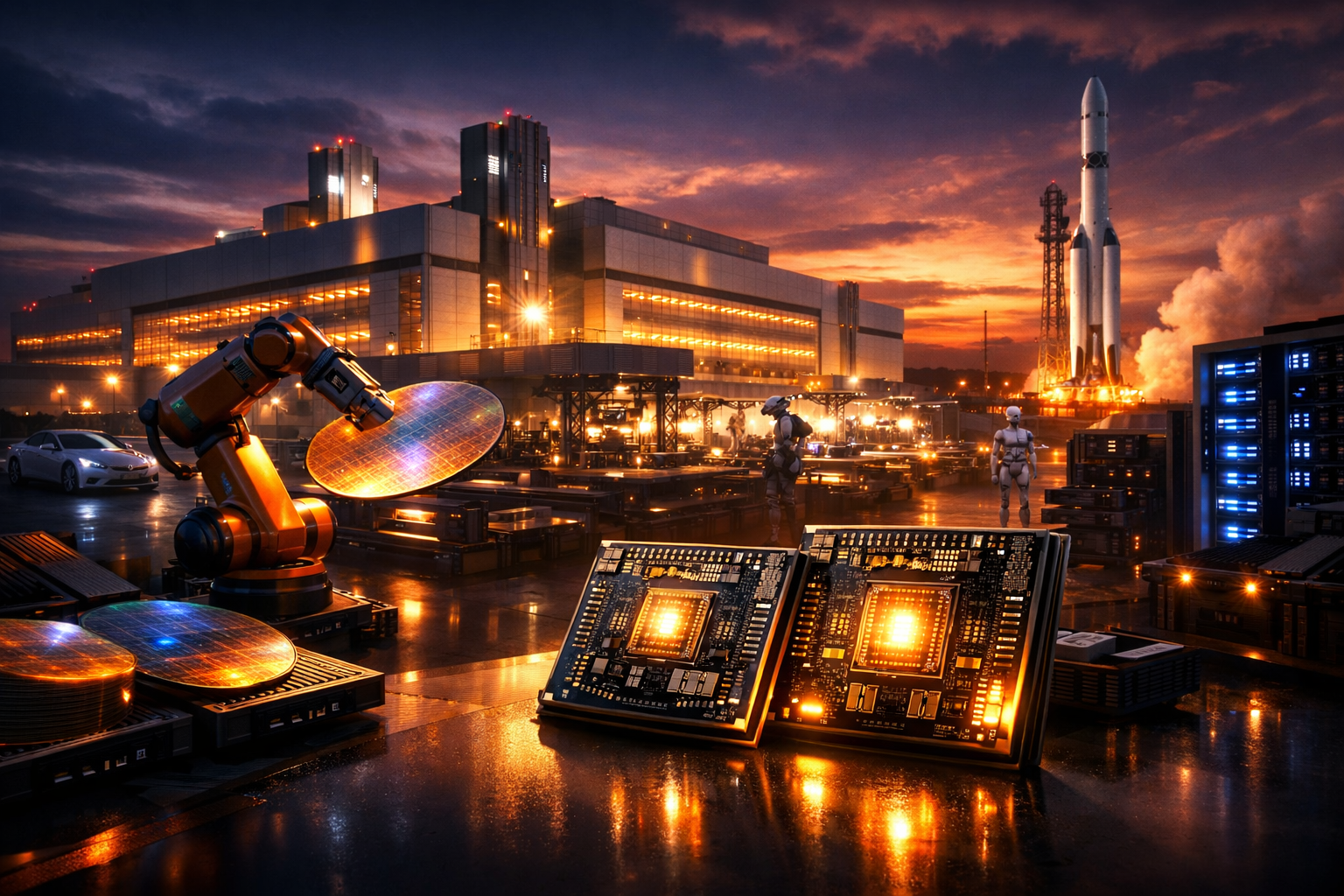
Intel joins Elon Musk’s Terafab chip megafactory in Texas as Tesla, SpaceX, and xAI push a massive new U.S. AI semiconductor manufacturing project

Intel has joined Elon Musk’s Terafab project in Texas, a massive proposed AI chip megafactory linked to Tesla, SpaceX, and xAI in one of the biggest semiconductor manufacturing bets of 2026.

The Intel Terafab AI chip project marks one of the most ambitious semiconductor manufacturing bets of 2026, bringing Elon Musk’s AI infrastructure vision into a new phase. By joining Terafab alongside Tesla, SpaceX, and xAI, Intel adds real manufacturing credibility to a project designed to expand U.S. AI chip production at massive scale.

Intel said it is joining the Terafab effort to help accelerate advanced chip manufacturing for AI and robotics. The announcement immediately raised the strategic importance of the project, which had previously been viewed by many as a bold concept but not yet a fully grounded industrial plan.

What the Intel Terafab AI Chip Project Actually Means

Terafab is positioned as a large-scale semiconductor manufacturing complex in Austin, Texas, built to support next-generation AI chips, robotics hardware, and compute infrastructure across Musk’s wider ecosystem. The broader idea is not just to secure chip supply, but to vertically integrate more of the stack behind AI systems, autonomous vehicles, humanoid robots, and hyperscale compute.

That makes this more than a factory story. It is a long-term infrastructure play.

Instead of depending entirely on external foundries and supply chains, Musk’s companies appear to be pushing toward tighter control over how advanced chips are designed, packaged, and deployed. If that strategy works, it could reshape how future AI infrastructure is built in the United States.

Why Intel Changes the Story

Before Intel entered the picture, Terafab looked highly ambitious but still speculative. The missing piece was a manufacturing partner with real experience in advanced chip fabrication and packaging. Intel fills that gap.

Its involvement gives Terafab something the project previously lacked in public perception: industrial legitimacy. Intel brings established semiconductor design and manufacturing depth, along with advanced packaging capabilities that are increasingly critical in the AI hardware race.

That does not guarantee success. Building fabs at this scale is capital-intensive, operationally difficult, and exposed to long timelines. But Intel’s participation makes the project far harder to dismiss.

A Major Test for Intel’s Turnaround

The Intel Terafab AI chip project could also become one of the most important external validations of Intel’s foundry strategy under CEO Lip-Bu Tan.

Intel has spent years trying to prove it can become a serious manufacturing partner for major outside customers, not just a chip designer for its own products. Joining a high-profile project tied to Tesla, SpaceX, and xAI gives Intel a chance to show that its manufacturing roadmap can matter again in the AI era.

If Terafab evolves into a real production platform, Intel could move from turnaround narrative to execution story. That would be significant not only for its foundry business, but for the broader U.S. push to expand domestic semiconductor capacity.

Why This Matters for the AI Chip Race

The global AI race is no longer only about who has the best models. It is also about who controls compute, power, packaging, and manufacturing.

That is why the Intel Terafab AI chip project stands out. It points to a future in which AI leaders want tighter control over the physical infrastructure behind training and deployment. Chips are no longer just components. They are strategic assets.

For Musk, Terafab fits a broader pattern of vertical integration. For Intel, it is a chance to anchor its comeback around AI infrastructure. For the market, it is another sign that semiconductor manufacturing is becoming one of the most contested layers of the AI economy.

Can Terafab Really Deliver?

That remains the central question.

Large industrial programs often sound far more coherent at announcement stage than they do in execution. Terafab still faces major uncertainty around timeline, output, economics, and implementation. The project’s full scope may evolve considerably from its initial framing.

But the significance of this announcement is not that Terafab is now certain to succeed. It is that the project has moved closer to being taken seriously by the market.

Intel’s entry changes the tone of the story from futuristic vision to plausible strategic buildout.

Final Take

The Intel Terafab AI chip project could become one of the defining semiconductor stories of 2026. It combines three of the most powerful themes in tech right now: AI compute scarcity, U.S. industrial policy, and vertical integration across advanced hardware ecosystems.

Even if Terafab takes years to prove itself, Intel joining the effort gives the project a level of credibility it did not have before. In a market increasingly defined by who can secure and scale compute, that shift matters.

Sources: Reuters · Bloomberg · TechCrunch · Electrek

About the Author

Neural Network World Editorial Team

Administrator

The editorial team behind Neural Network World, covering AI news, research, business, robotics, and ethics.

Visit Website View All Posts

Post navigation

Previous: Why Most AI Projects Fail – And What the Data Really Shows
Next: Samsung Q1 Profit Hits $37.9B – Up 8x as AI Chip Demand Shatters Records

Related Stories

Young office workers in a corporate setting facing AI automation, with dashboards showing job losses and economic data, illustrating Goldman Sachs research on AI-driven employment disruption in the U.S. labor market
  • AI Business

Goldman Sachs: AI Cuts 16,000 U.S. Jobs per Month, Gen Z Hardest Hit

Neural Network World Editorial Team April 8, 2026
Anthropic-themed AI command center above a massive data center campus, with revenue growth dashboards and advanced TPU chip infrastructure symbolizing the company’s $30 billion annualized revenue and major Google-Broadcom compute deal
  • AI Business

Anthropic Hits $30B Revenue Run Rate, Signs 3.5GW TPU Deal

Neural Network World Editorial Team April 8, 2026
OpenAI calls for robot taxes, a public wealth fund, and a 4-day workweek in this Washington AI policy summit illustration
  • AI Business

OpenAI Calls for Robot Taxes and a Public Wealth Fund – and Faces an Immediate Credibility Crisis

Neural Network World Editorial Team April 8, 2026
Generic selectors
Exact matches only
Search in title
Search in content
Post Type Selectors

Trending News

Goldman Sachs: AI Cuts 16,000 U.S. Jobs per Month, Gen Z Hardest Hit Young office workers in a corporate setting facing AI automation, with dashboards showing job losses and economic data, illustrating Goldman Sachs research on AI-driven employment disruption in the U.S. labor market 1
  • AI Business

Goldman Sachs: AI Cuts 16,000 U.S. Jobs per Month, Gen Z Hardest Hit

Neural Network World Editorial Team April 8, 2026
AI Slashes Qubits to Break Encryption From Millions to 10,000 Futuristic quantum computing lab with an AI neural interface, compressed qubit stacks, and RSA encryption shields, illustrating an AI-discovered error-correction breakthrough that could accelerate quantum attacks on internet security 2
  • AI Research

AI Slashes Qubits to Break Encryption From Millions to 10,000

Neural Network World Editorial Team April 8, 2026
Anthropic Hits $30B Revenue Run Rate, Signs 3.5GW TPU Deal Anthropic-themed AI command center above a massive data center campus, with revenue growth dashboards and advanced TPU chip infrastructure symbolizing the company’s $30 billion annualized revenue and major Google-Broadcom compute deal 3
  • AI Business

Anthropic Hits $30B Revenue Run Rate, Signs 3.5GW TPU Deal

Neural Network World Editorial Team April 8, 2026
OpenAI Calls for Robot Taxes and a Public Wealth Fund – and Faces an Immediate Credibility Crisis OpenAI calls for robot taxes, a public wealth fund, and a 4-day workweek in this Washington AI policy summit illustration 4
  • AI Business

OpenAI Calls for Robot Taxes and a Public Wealth Fund – and Faces an Immediate Credibility Crisis

Neural Network World Editorial Team April 8, 2026
Samsung Q1 Profit Hits $37.9B – Up 8x as AI Chip Demand Shatters Records Samsung record Q1 2026 profit driven by AI memory chip demand, with HBM chips, semiconductor fabs, and hyperscale AI data centers 5
  • AI Business

Samsung Q1 Profit Hits $37.9B – Up 8x as AI Chip Demand Shatters Records

Neural Network World Editorial Team April 8, 2026

Neural Network World

Neural Network World

Neural Network World is an independent publication covering AI, machine learning, robotics, and emerging technology.

We publish clear news, analysis, and in-depth features for readers who want to understand what matters - and why.

contact@neuralnetworkworld.com

Company

  • Contact
  • Privacy Policy
  • Terms of Use
  • Editorial Policy
  • About Neural Network World

Sections

  • AI News
  • AI Business
  • AI Research
  • AI Ethics
  • Machine Learning
  • Robotics

Start Here

  • Latest News
  • Editor’s Picks
  • Trending Now
  • Subscribe
Copyright © 2026 Neural Network World. All rights reserved.

►
Necessary cookies enable essential site features like secure log-ins and consent preference adjustments. They do not store personal data.
None
►
Functional cookies support features like content sharing on social media, collecting feedback, and enabling third-party tools.
None
►
Analytical cookies track visitor interactions, providing insights on metrics like visitor count, bounce rate, and traffic sources.
None
►
Advertisement cookies deliver personalized ads based on your previous visits and analyze the effectiveness of ad campaigns.
None
►
Unclassified cookies are cookies that we are in the process of classifying, together with the providers of individual cookies.
None