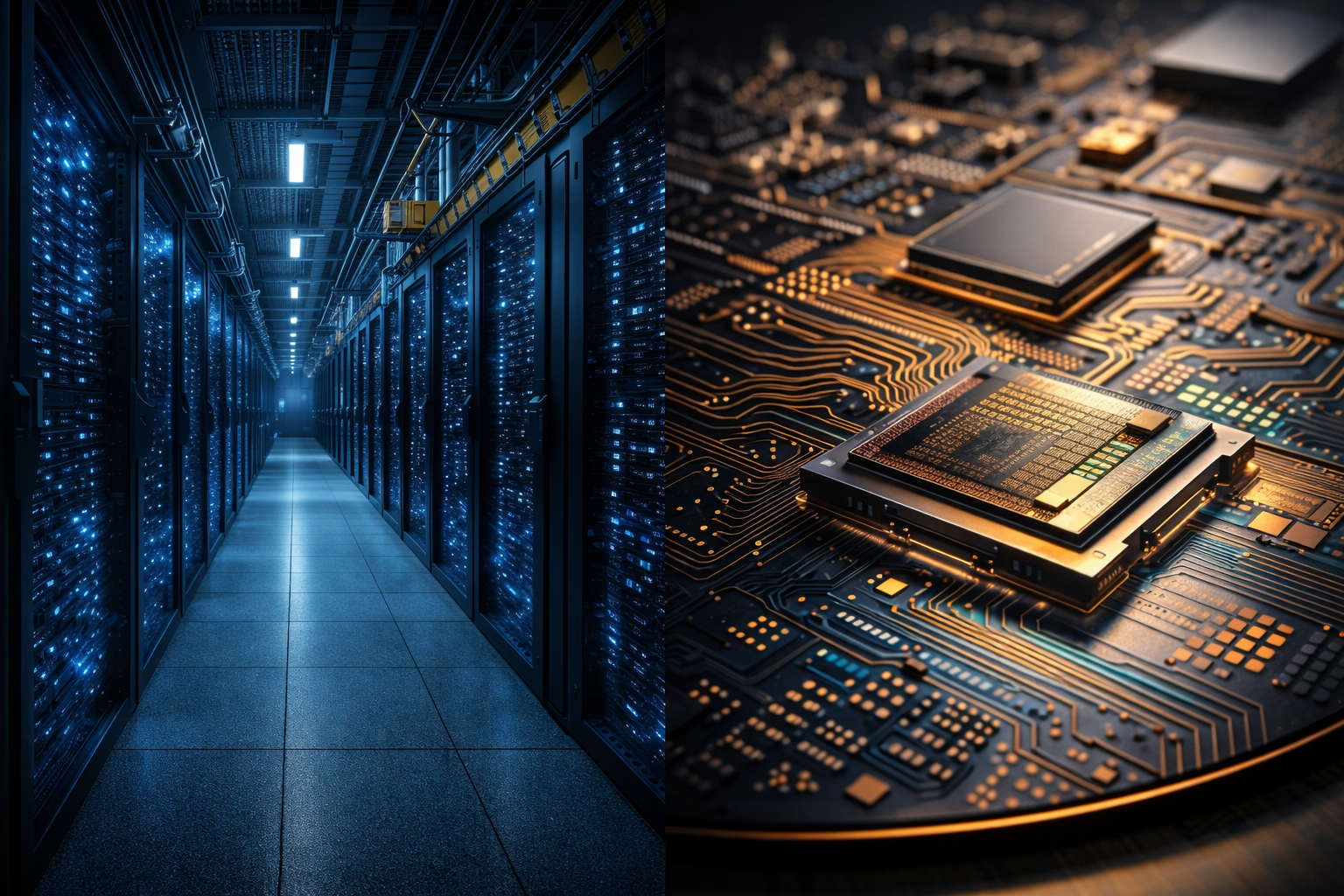
Amazon is pairing AI revenue disclosures with an aggressive push to make custom chips a core platform advantage.
Amazon finally did the thing markets have been demanding: it put a number on “AI revenue.”
In his annual shareholder letter, CEO Andy Jassy disclosed that AWS’s AI revenue run-rate is over $15 billion in Q1 2026. Reuters notes this is the first time Amazon has publicly reported numbers for an AI business it has funded with billions in investment; the same report says the annualized figure represents roughly 10% of AWS’s $142 billion revenue run-rate.
On its own, $15 billion is a headline. In context, it’s a narrative pivot.
AWS is in the middle of a capex supercycle. Reuters reports Amazon projected $200 billion in capital expenditure this year, mostly focused on AI, a figure that spooked investors and fueled bubble anxiety. But Jassy’s message is that this is not speculative overbuild. Reuters quotes him saying Amazon is not investing “on a hunch,” and reports his claim that the company already has customer commitments for a substantial portion of expected AWS capex, much of which Amazon expects to monetize in 2027–2028. The shareholder letter pushes the same framing in more explicit language: “We’re not investing approximately $200 billion in capex in 2026 on a hunch,” and it points to customer commitments that make the spending “predictable.”
In other words: Amazon is trying to turn AI capex into something closer to “build-to-order,” even if the capacity is still physically installed ahead of billing.
The letter adds a second datapoint that investors will treat as equally important: power. Jassy writes that AWS added 3.9 gigawatts of new power capacity in 2025 and expects to double total power capacity by the end of 2027 – while still describing capacity constraints that create “unserved demand.” This matters because, at hyperscale, “AI strategy” is downstream of grid access and construction tempo.
Then he goes where the subtext has been pointing for months: chips.
Reuters reports Amazon’s custom chip business – covering Graviton, Trainium, and Nitro – now has an annualized revenue run-rate over $20 billion, doubling from the $10 billion the company disclosed alongside fourth-quarter results, and adds that Jassy suggested Amazon could eventually sell its chips to outside customers. The shareholder letter echoes the same direction and goes further, describing a scenario where selling chips to AWS and third parties could imply a ~$50 billion annual run-rate, and stating it’s “quite possible” Amazon will sell racks to third parties.
This is not just product optimism. It’s margin architecture.
Jassy argues that custom silicon changes the economics of AWS – in the letter, he claims Trainium can save “tens of billions” in capex per year at scale and provide “several hundred basis points” of operating margin advantage versus relying on others’ chips for inference. Whether those numbers survive independent scrutiny over time, the strategic claim is clean: if AWS controls silicon, it can compete on both price-performance and profit.
There’s an obvious competitive implication: custom silicon is becoming the hyperscaler’s answer to Nvidia lock-in. Reuters explicitly frames the chip push as part of the broader effort by big tech to cut dependence on Nvidia’s costly AI chips. Jassy’s letter also acknowledges the relationship (“we have a strong partnership with NVIDIA”) while presenting the “better price-performance” pitch as the reason customers will diversify.
One more nuance: the run-rate metric is informative but not a clean apples-to-apples scoreboard. Reuters notes that run-rate extrapolates annual performance from the period measured and that comparisons across companies depend heavily on timing. Still, Amazon has moved from rhetoric to at least one measurable benchmark – and that’s likely exactly why this disclosure landed now.
The bet Amazon is making is straightforward: if the AI buildout is as durable as management suggests, AWS becomes both the store and the factory. It rents the compute, and it sells (or at least monetizes) increasing shares of the underlying silicon.
If Amazon really does start selling racks to third parties, it would be the clearest sign yet that hyperscalers no longer see chips as a cost center. They see chips as a product line – and a lever to reshape the industry’s price curve.
Sources: Reuters · Amazon Shareholder Letter
About the Author