OpenAI’s historic funding round pushes the company deeper into the high-stakes world of AI infrastructure and IPO expectations.
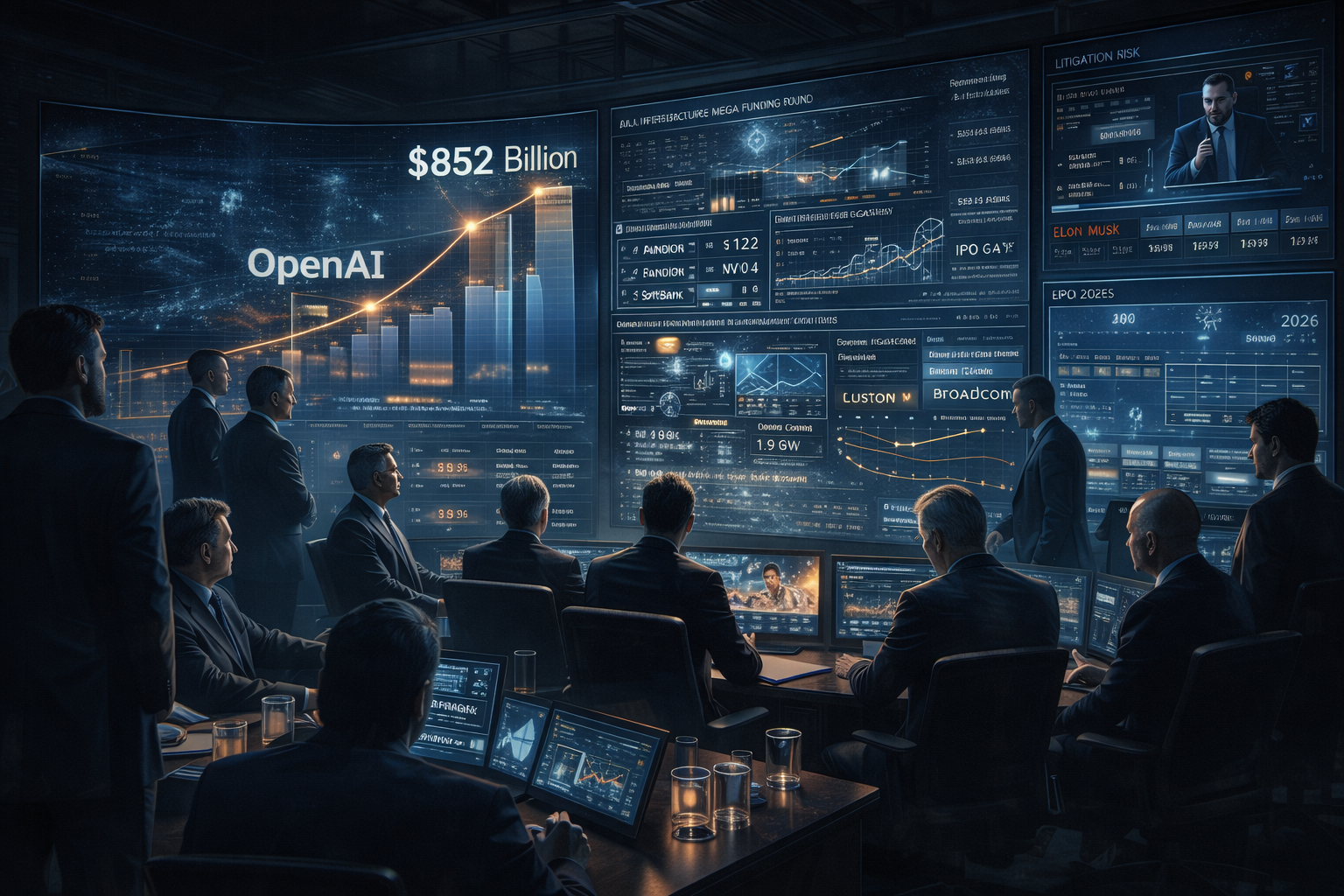
OpenAI closed the largest private funding round in history on March 31, 2026. The company raised $122 billion at an $852 billion valuation. The round dwarfs its own previous record – a $40 billion raise just one year prior – and is roughly nine times larger than Ant Group’s $14 billion, which held the overall private-company record before AI reshaped startup finance.
The round is anchored by Amazon ($50 billion), NVIDIA ($30 billion), and SoftBank ($30 billion). Yet the headline figure masks a complex deal laced with contingencies, compute credits, and growing internal tension over what comes next.
Why It Matters
Not all $122 billion is cash. Amazon’s $50 billion includes only a $15 billion initial tranche. The remaining $35 billion is contingent on OpenAI going public or achieving AGI by December 31, 2028. NVIDIA’s $30 billion consists primarily of compute credits. SoftBank’s $30 billion arrives in quarterly tranches through late 2026. At close, analysts estimate only around $37 billion in actual cash reached OpenAI’s accounts.
The money flows toward massive infrastructure buildout. OpenAI has secured three gigawatts of dedicated NVIDIA inference capacity and is developing custom chips with Broadcom. Deutsche Bank estimates roughly $143 billion in negative cumulative free cash flow between 2024 and 2029 before profitability arrives. For the AI Business sector, this round signals that AI infrastructure spending has entered a phase where traditional venture metrics no longer apply.
CFO Sarah Friar confirmed OpenAI will allocate IPO shares to retail investors. She told CNBC: “At our scale, raising equity forever doesn’t make any sense.” Meanwhile, the company generates $2 billion per month in revenue – roughly $24 billion annualized – with 900 million weekly active users and 50 million subscribers.
What’s Next
The IPO path is not straightforward. Sam Altman is pushing for a Q4 2026 listing. Friar has privately told colleagues the company will not be ready until 2027. Reports indicate Altman has excluded Friar from some financial meetings. Both issued a joint statement saying they are “fully aligned.” No S-1 has been filed as of April 10, 2026. Prediction markets place IPO-by-year-end odds below 50%.
Elon Musk’s lawsuit goes to trial on April 27, 2026 in Oakland federal court. Damages sought range between $78 billion and $135 billion. On the secondary market, sentiment has cooled – Bloomberg reported that roughly $600 million in OpenAI shares from institutional holders could not find buyers as some investors pivoted to Anthropic, which has reportedly surpassed OpenAI in annualized revenue at $30 billion versus approximately $25 billion.
On April 9, OpenAI paused its UK Stargate data center project, citing energy costs – a move analysts interpreted as reining in spending ahead of a public listing. The company also circulated an investor memo claiming a compute infrastructure advantage over Anthropic: 1.9 gigawatts of capacity versus Anthropic’s 1.4 GW, with projections of 30 GW by 2030. The core tension is clear. OpenAI’s ambition requires capital at a scale never before attempted by a private company. But its leadership cannot agree on when the company is ready to face the accountability that public markets demand.
Sources: OpenAI · Bloomberg · CNBC · CNBC IPO · Fortune
About the Author