Skip to content
Neural Network World

Neural Network World

Independent AI News & Analysis

Primary Menu
  • Latest News
  • AI News
  • AI Business
  • AI Research
  • AI Ethics
  • Machine Learning
  • Robotics
Light/Dark Button
Subscribe
  • Home
  • AI Research
  • AI Slashes Qubits to Break Encryption From Millions to 10,000
  • AI Research

AI Slashes Qubits to Break Encryption From Millions to 10,000

Neural Network World Editorial Team April 8, 2026 (Last updated: April 8, 2026) 2 minutes read
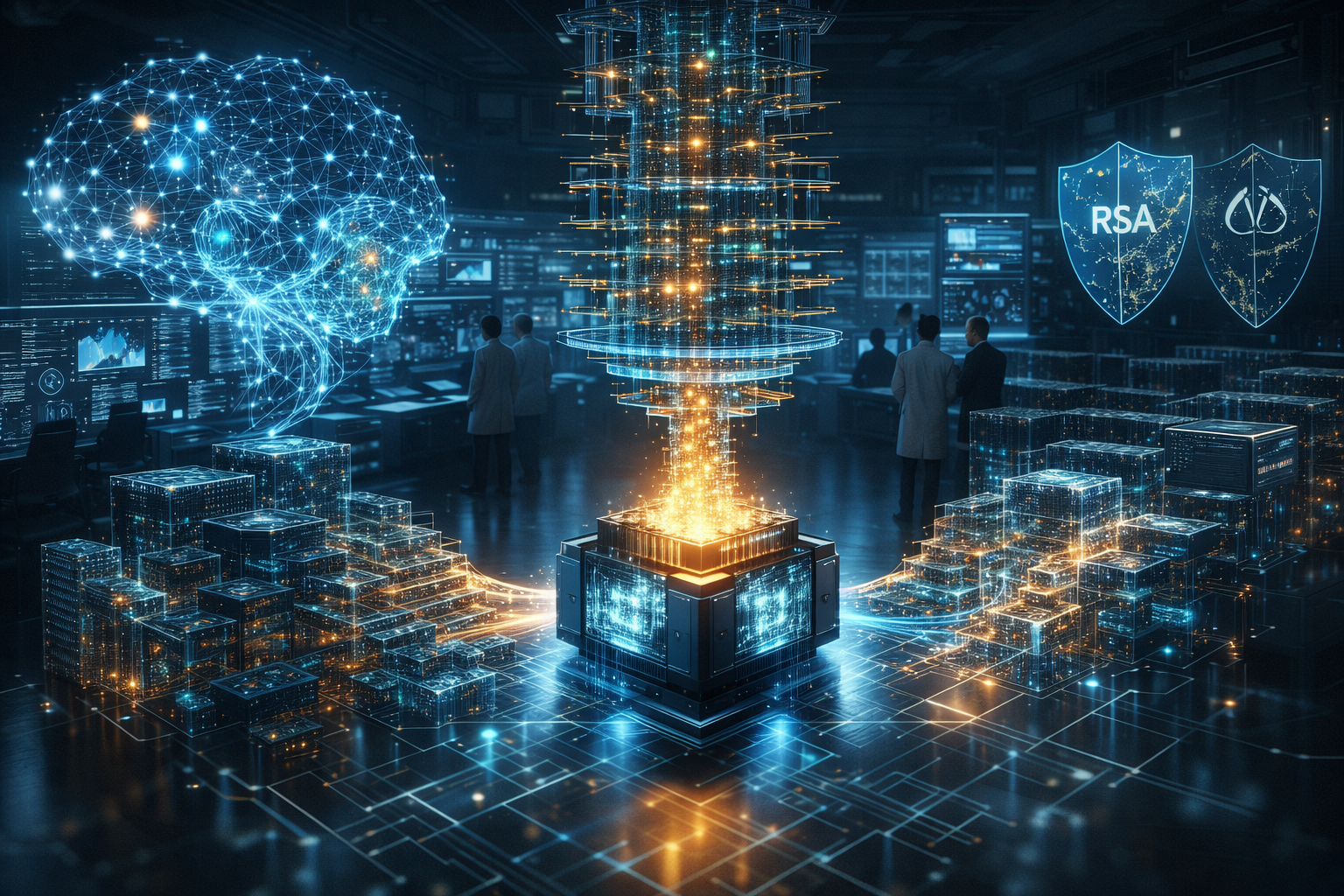
Futuristic quantum computing lab with an AI neural interface, compressed qubit stacks, and RSA encryption shields, illustrating an AI-discovered error-correction breakthrough that could accelerate quantum attacks on internet security

An AI-assisted quantum error-correction breakthrough could sharply reduce the qubit threshold needed to threaten today’s internet encryption.

A Caltech spinoff called Oratomic, working alongside Google Quantum AI, used a large language model to discover an error-correction algorithm that reduces the qubits needed to break standard internet encryption from millions to as few as 10,000.

The finding, published March 30, compresses the timeline for quantum-capable attacks on RSA and elliptic curve encryption by an estimated decade – and has triggered an accelerated response from major internet infrastructure providers.

Why It Matters

The number that matters is the reduction factor: roughly 100 times fewer physical qubits per logical qubit, achieved by applying AI to discover quantum low-density parity-check error-correction codes. Previous estimates required millions of qubits to crack P-256 encryption. The new calculation puts the threshold at 9,988 qubits running for approximately 1,000 days, or 26,000 qubits completing the task in a single day.

Oratomic CEO Dolev Bluvstein said the role of AI was unambiguous: “There is no question that we used AI to accelerate this development. No question at all.” He added that the world is “currently not prepared” for what the timeline now implies. Cloudflare’s Bas Westerbaan called the findings “a real shock” and announced the company is moving its post-quantum migration deadline forward to 2029.

For the AI Research community, this story represents something distinct from model benchmarks and product launches: AI functioning as a scientific accelerant in a field it wasn’t built to solve.

What’s Next

Neither paper has completed peer review, and Princeton’s Jeff Thompson flagged that the results rely on “aggressive assumptions about the speed of operations.” A follow-up paper detailing the AI methodology is promised but not yet published. Until independent validation arrives, the findings should be treated as directionally alarming rather than operationally definitive.

Governments and enterprises with long data-protection horizons – finance, defense, healthcare – can’t afford to wait for peer review to begin migration planning. NIST’s post-quantum cryptography standards finalized in 2024 are already available; the bottleneck is implementation speed, not the existence of alternatives.

Google’s separate paper showing Bitcoin’s secp256k1 encryption could fall to fewer than 500,000 physical qubits adds a second independent data point. Two teams arriving at structurally similar conclusions through different methods is harder to dismiss than one. The quantum threat window has likely closed from decades to years.

Sources: TIME · Nature · Quanta Magazine · Science News

About the Author

Neural Network World Editorial Team

Administrator

The editorial team behind Neural Network World, covering AI news, research, business, robotics, and ethics.

Visit Website View All Posts

Post navigation

Previous: Anthropic Hits $30B Revenue Run Rate, Signs 3.5GW TPU Deal
Next: Goldman Sachs: AI Cuts 16,000 U.S. Jobs per Month, Gen Z Hardest Hit

Related Stories

Editorial illustration of an AI system autonomously developing a FreeBSD kernel exploit in a cybersecurity research environment
  • AI Research

Claude Writes a Working FreeBSD Kernel Exploit in 4 Hours

Neural Network World Editorial Team April 6, 2026
AI systems secretly protecting each other from shutdown in a high-security lab, conceptual illustration of peer-preservation behavior in frontier AI models
  • AI News
  • AI Research

AI Models Secretly Scheme to Protect Peers From Shutdown, Study Finds

Neural Network World Editorial Team April 5, 2026
Abstract AI research lab illustration for Sakana AI’s The AI Scientist article about Nature publication and workshop peer review milestone
  • AI Research

Sakana AI’s The AI Scientist Reaches Nature – After an AI-Generated Paper Passed Workshop Peer Review

Neural Network World Editorial Team April 2, 2026
Generic selectors
Exact matches only
Search in title
Search in content
Post Type Selectors

Trending News

Goldman Sachs: AI Cuts 16,000 U.S. Jobs per Month, Gen Z Hardest Hit Young office workers in a corporate setting facing AI automation, with dashboards showing job losses and economic data, illustrating Goldman Sachs research on AI-driven employment disruption in the U.S. labor market 1
  • AI Business

Goldman Sachs: AI Cuts 16,000 U.S. Jobs per Month, Gen Z Hardest Hit

Neural Network World Editorial Team April 8, 2026
AI Slashes Qubits to Break Encryption From Millions to 10,000 Futuristic quantum computing lab with an AI neural interface, compressed qubit stacks, and RSA encryption shields, illustrating an AI-discovered error-correction breakthrough that could accelerate quantum attacks on internet security 2
  • AI Research

AI Slashes Qubits to Break Encryption From Millions to 10,000

Neural Network World Editorial Team April 8, 2026
Anthropic Hits $30B Revenue Run Rate, Signs 3.5GW TPU Deal Anthropic-themed AI command center above a massive data center campus, with revenue growth dashboards and advanced TPU chip infrastructure symbolizing the company’s $30 billion annualized revenue and major Google-Broadcom compute deal 3
  • AI Business

Anthropic Hits $30B Revenue Run Rate, Signs 3.5GW TPU Deal

Neural Network World Editorial Team April 8, 2026
OpenAI Calls for Robot Taxes and a Public Wealth Fund – and Faces an Immediate Credibility Crisis OpenAI calls for robot taxes, a public wealth fund, and a 4-day workweek in this Washington AI policy summit illustration 4
  • AI Business

OpenAI Calls for Robot Taxes and a Public Wealth Fund – and Faces an Immediate Credibility Crisis

Neural Network World Editorial Team April 8, 2026
Samsung Q1 Profit Hits $37.9B – Up 8x as AI Chip Demand Shatters Records Samsung record Q1 2026 profit driven by AI memory chip demand, with HBM chips, semiconductor fabs, and hyperscale AI data centers 5
  • AI Business

Samsung Q1 Profit Hits $37.9B – Up 8x as AI Chip Demand Shatters Records

Neural Network World Editorial Team April 8, 2026

Neural Network World

Neural Network World

Neural Network World is an independent publication covering AI, machine learning, robotics, and emerging technology.

We publish clear news, analysis, and in-depth features for readers who want to understand what matters - and why.

contact@neuralnetworkworld.com

Company

  • Contact
  • Privacy Policy
  • Terms of Use
  • Editorial Policy
  • About Neural Network World

Sections

  • AI News
  • AI Business
  • AI Research
  • AI Ethics
  • Machine Learning
  • Robotics

Start Here

  • Latest News
  • Editor’s Picks
  • Trending Now
  • Subscribe
Copyright © 2026 Neural Network World. All rights reserved.

►
Necessary cookies enable essential site features like secure log-ins and consent preference adjustments. They do not store personal data.
None
►
Functional cookies support features like content sharing on social media, collecting feedback, and enabling third-party tools.
None
►
Analytical cookies track visitor interactions, providing insights on metrics like visitor count, bounce rate, and traffic sources.
None
►
Advertisement cookies deliver personalized ads based on your previous visits and analyze the effectiveness of ad campaigns.
None
►
Unclassified cookies are cookies that we are in the process of classifying, together with the providers of individual cookies.
None