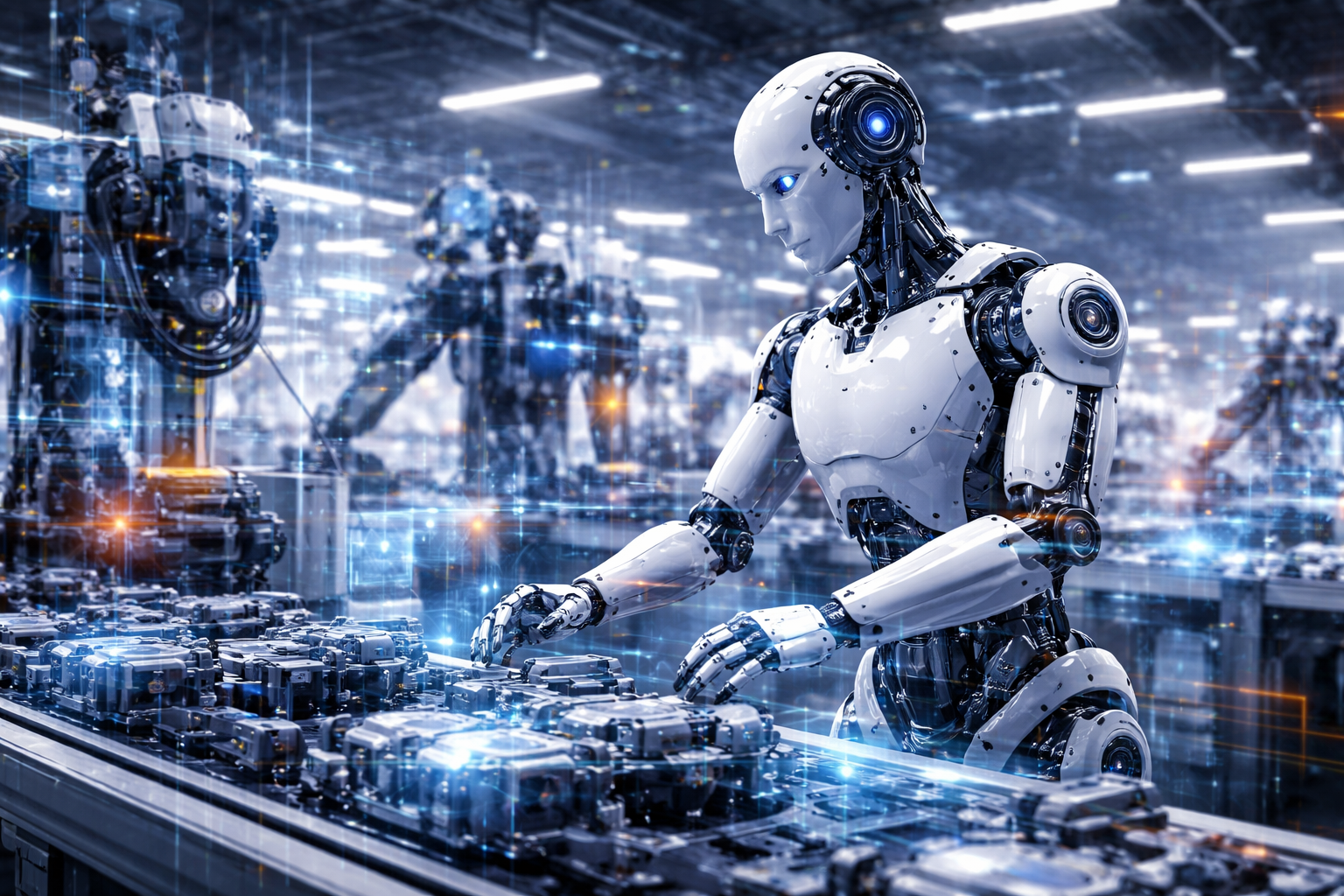
Concept illustration of physical AI deployment in manufacturing with a humanoid robot on a factory floor.
For years, the most impressive robot demonstrations lived on conference stages and YouTube videos. In 2026, that is changing. Physical AI – the integration of artificial intelligence with robotic hardware that operates in the real world – is making the leap from controlled lab environments to production floors, warehouses, and logistics centers.
NVIDIA CEO Jensen Huang captured the moment at the company’s GTC 2026 conference in March, declaring that the “ChatGPT moment for robotics is here.” Behind the headline, a convergence of breakthroughs in simulation, sensor technology, and AI models is making this transition possible.
The Simulation-to-Reality Breakthrough
One of the most persistent challenges in robotics has been the “sim-to-real” gap – the difference between how a robot performs in a simulated environment and how it handles the messy unpredictability of the real world. In March 2026, ABB and NVIDIA announced they had effectively closed this gap for industrial robotics applications.
Using NVIDIA’s Omniverse platform, manufacturers can now create high-fidelity digital twins of entire factory environments, train robots in simulation, and deploy them in physical settings with minimal additional tuning. This dramatically reduces the time and cost of robot deployment, which has historically been one of the biggest barriers to adoption.
New Open Models for Robot Learning
NVIDIA released several open physical AI models in March 2026, including updates to its Cosmos and GR00T frameworks. These models allow robots to understand their physical environment, reason about objects and obstacles, and plan sequences of actions to achieve goals.
The key word is “open.” By making these foundational models freely available, NVIDIA is enabling a broad ecosystem of robotics companies to build on shared infrastructure rather than developing everything from scratch. This mirrors the approach that accelerated software AI development, where open models and shared tools lowered barriers to entry across the industry.
Humanoids Move Toward Production
Humanoid robots were a dominant theme at CES 2026. Boston Dynamics showcased its Atlas robot, which demonstrated natural, human-like walking and gesture capabilities. Hyundai, which owns Boston Dynamics, announced plans to deploy humanoid robots in a US factory by 2028, with a dedicated production facility designed to manufacture 30,000 units annually.
LG introduced the CLOiD robot as part of its vision for a “zero labor home.” NEURA Robotics presented its humanoid4NE1 platform. Qualcomm launched the Dragonwing IQ10 processor specifically designed to power humanoid robots in real-world environments.
While full-scale humanoid deployment remains a few years away, the level of investment and the specificity of production plans suggest this is no longer a research curiosity but an emerging industrial sector.
The Market Numbers
The global market for industrial robot installations has reached an all-time high of $16.7 billion, according to the International Federation of Robotics. Annual installations have exceeded 500,000 units for the fourth consecutive year.
Meanwhile, a Rivian spinoff raised $500 million specifically to build AI-powered factory robots, and PepsiCo is working with Siemens and NVIDIA to convert manufacturing facilities into high-fidelity digital twins. These early deployments have already delivered measurable results: a 20% increase in throughput, faster design cycles, and 10-15% reductions in capital expenditure.
Challenges Ahead
The IFR’s 2026 trends report identifies several obstacles that could slow progress. Safety and liability frameworks have not kept pace with the increasing autonomy of AI-driven robots. Deep learning models that act as “black boxes” create legal ambiguity around who is responsible when an autonomous system causes harm.
Cybersecurity is another growing concern. As robots become connected to cloud platforms and enterprise networks, they present new attack surfaces. The IFR reports increasing hacking attempts targeting robot controllers and cloud-connected systems.
Despite these challenges, the economic case for physical AI deployment has become compelling enough to absorb the remaining technical risk. The organizations leading the charge are those solving specific, high-value problems rather than pursuing general-purpose humanoid dreams.
About the Author