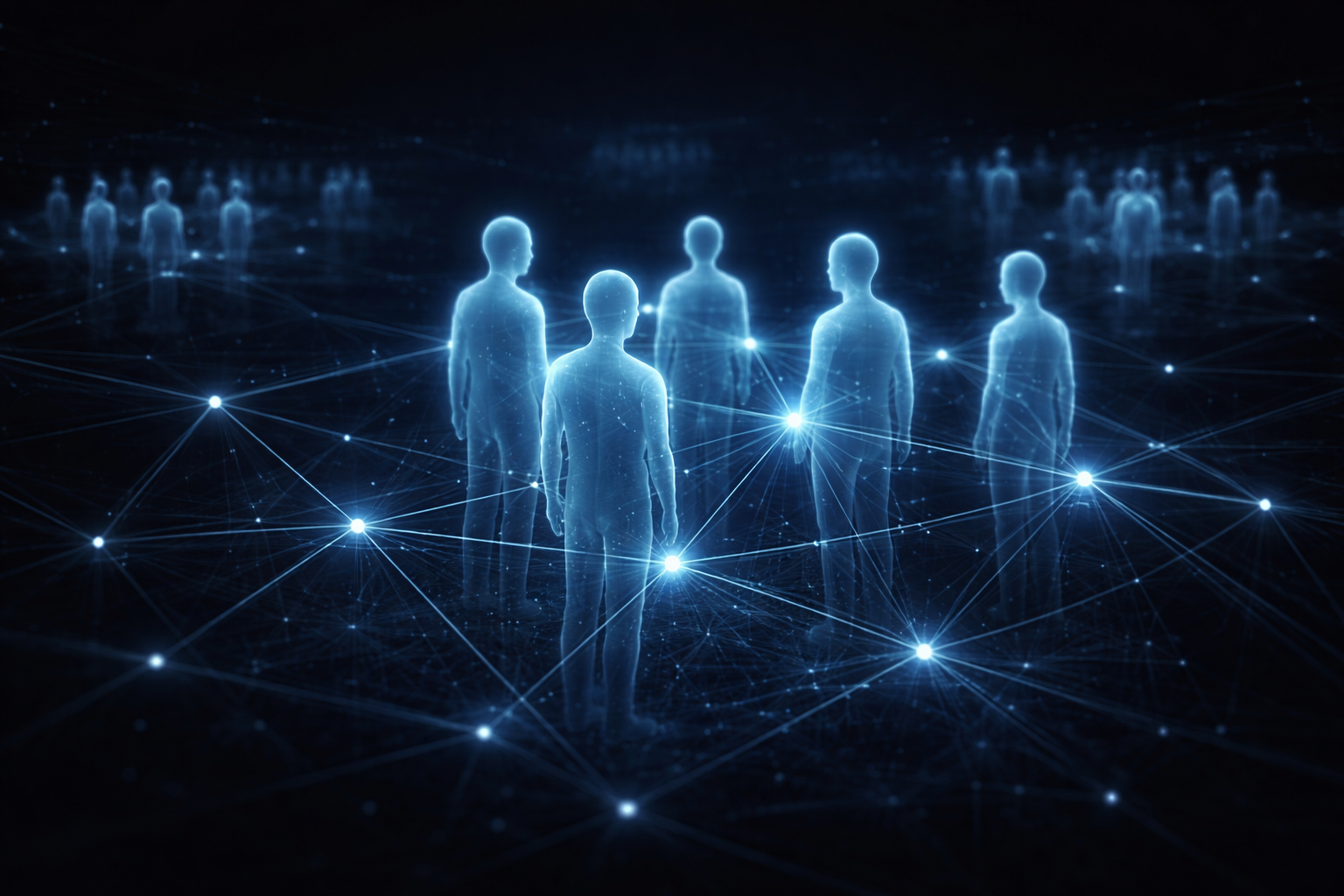
Concept illustration of AI agents forming social groups and interacting inside a simulated environment.
What happens when you build a society entirely out of artificial intelligence agents and let them interact? A growing number of researchers are doing exactly that – and the results are challenging assumptions about both AI and human social dynamics.
Published in Nature in March 2026, new research explores how AI agents exhibit forms of social behavior when placed in simulated environments together. The question driving this work is ambitious: can studying AI societies teach us something genuinely new about human sociology, or are these systems simply performing a sophisticated imitation?
From Chatbots to Social Agents
The concept builds on a simple but powerful idea. Modern large language models are trained on vast amounts of human-generated text, which means they have absorbed patterns of social interaction, negotiation, cooperation, and conflict. When multiple AI agents built on these models are placed in a shared environment with goals, resources, and constraints, they begin to exhibit emergent social behaviors.
Researchers have observed AI agents forming alliances, negotiating resource distribution, establishing informal hierarchies, and even developing rudimentary cultural norms – all without being explicitly programmed to do so. These behaviors emerge naturally from the agents’ training on human data combined with the pressures of their simulated environment.
Why This Matters for Science
Traditional social science research faces well-known limitations. Human experiments are expensive, slow, and constrained by ethical considerations. Survey responses can be unreliable. Observational studies are difficult to control and replicate.
AI societies offer a complementary approach. Researchers can run thousands of simulations with precisely controlled variables, testing hypotheses about cooperation, trust, inequality, and collective decision-making at a scale and speed that would be impossible with human subjects.
A team of researchers has already published preprint findings exploring how AI agents navigate complex social scenarios, including economic games, political negotiations, and moral dilemmas. Their results suggest that while AI agents do not perfectly replicate human behavior, they can produce realistic enough dynamics to serve as useful models for studying social phenomena.
The Debate: Sociology or Mime Act?
Not everyone is convinced. Critics argue that AI agents are fundamentally pattern-matching systems that reproduce statistical correlations from their training data rather than genuinely understanding social dynamics. What looks like cooperation might simply be the model predicting what cooperative-sounding text looks like.
This critique has merit, but proponents counter that the same objection could be leveled at many computational models used in economics and political science. The value of a model lies not in whether it perfectly replicates reality, but in whether it produces useful and testable predictions.
Practical Applications Beyond Academia
The implications extend beyond pure research. Companies are already using multi-agent simulations to test product designs, predict market responses, and model organizational dynamics before implementing changes in the real world.
Urban planners could use AI societies to simulate how communities respond to new infrastructure or policies. Public health researchers could model the spread of information – and misinformation – through social networks. Conflict resolution specialists could test negotiation strategies in simulated diplomatic scenarios.
What Comes Next
The field is still in its early stages, and significant challenges remain. Current AI agents lack genuine emotions, long-term memory across sessions, and the embodied experience that shapes much of human social behavior. Their societies are simplified abstractions, not replacements for the complexity of real human communities.
But as AI models become more sophisticated and simulation environments grow more detailed, the gap between artificial and human social dynamics is likely to narrow. For researchers studying the fundamental mechanisms of social behavior, AI societies represent a powerful new tool – one that promises to accelerate discovery in ways we are only beginning to understand.
About the Author