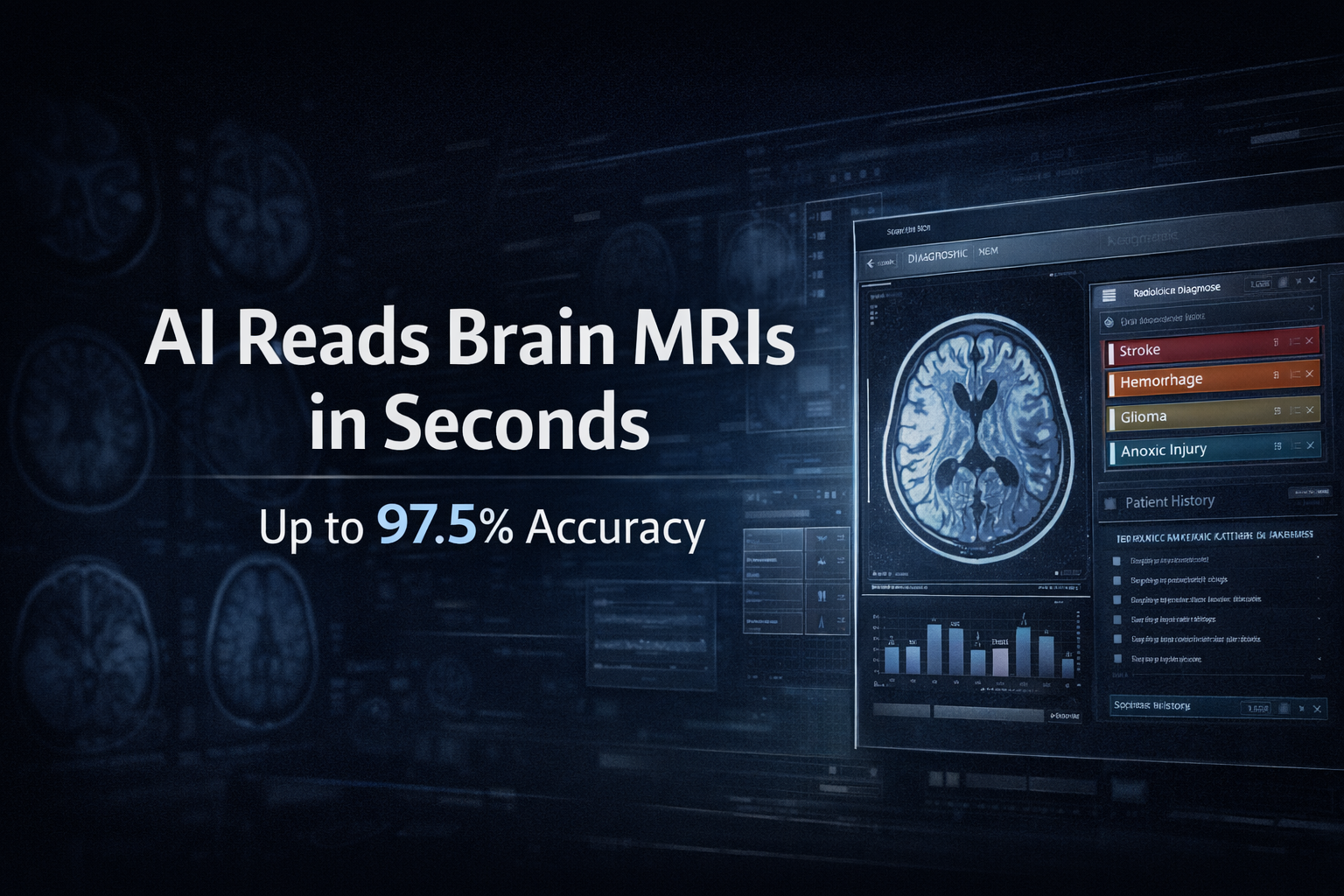
University of Michigan researchers say their AI model can analyze brain MRIs in seconds with up to 97.5% accuracy.
Researchers at the University of Michigan have developed an AI model called Prima that can analyze brain MRI scans in seconds, detect neurological conditions with up to 97.5% accuracy, and help determine which cases need urgent clinical attention. The findings were published in Nature Biomedical Engineering.
Why this matters
Brain MRI interpretation is often time-sensitive, especially in cases such as stroke or brain hemorrhage, where delays can affect treatment decisions and patient outcomes. University of Michigan researchers say Prima is designed to speed up that process by providing fast diagnostic support and prioritizing the most urgent cases.
What Prima does
According to Michigan Medicine, Prima is a vision language model built for neuroimaging. It was trained on more than 200,000 MRI studies and 5.6 million imaging sequences collected since radiology digitization began at University of Michigan Health. The system also incorporates patient clinical history and the reason an imaging study was ordered, allowing it to interpret scans in a way that more closely resembles real clinical workflow.
The research team says the model was evaluated on more than 30,000 MRI studies over one year. Across more than 50 radiologic diagnoses involving major neurological disorders, Prima outperformed other advanced AI models and also showed an ability to rank cases by urgency.
A potential triage tool, not a replacement
The strongest near-term use case may be triage. The Michigan team says Prima can help flag high-priority cases such as stroke or brain hemorrhage and notify the appropriate specialist more quickly. That could make the model useful in overstretched health systems, especially where radiology staffing is limited.
At the same time, the researchers describe the work as being in an early evaluation phase. Future work will explore integrating more detailed patient information and electronic medical record data to improve diagnostic performance further.
The bigger picture
Prima is notable because it moves beyond narrow medical imaging AI tools trained for a single task. Michigan Medicine describes it as a broader neuroimaging foundation model, raising the possibility that similar systems could eventually be adapted for other imaging modalities such as mammograms, chest X-rays, and ultrasound.
Bottom line
The headline here is already strong without overstatement: a University of Michigan AI model can read brain MRIs in seconds, reached up to 97.5% accuracy in reported results, and may help hospitals prioritize urgent neurological cases faster.
About the Author